 |
繁體 | 简体 | ENG |

|
|||||||||||
|
|
|||||||||||
| Home | About Us | Product | Partnerships | Ordering | News | Contact Us | About Xinjiang | ||||
|
 |
||||
Xinjiang Profile The Silk Road was an important trade route, sharing economic culture and technology between ancient China and the West. Xinjiang, as the Western gate of China on the Silk Road, has rapidly developed as a key part of the transportation route between China and the Eurasian countries. The ancient Silk Road has been revived. This information is to help you understand more about the diverse Xinjiang people, land and passions. Location
Xinjiang Uyghur Autonomous Region (Xinjiang in brief) is located in the centre of the Eurasian landmass and at the very Northwestern corner of China. Covering 1,660,000 square kilometres, it has the largest land area among all the Chinese provincial level administrative regions. It accounts for about one sixth of China’s total territory. It borders eight countries: Russia, Kazakhstan, Kyrgyzstan, Tajikistan, Pakistan, Mongolia, India and Afghanistan. Geographical Features
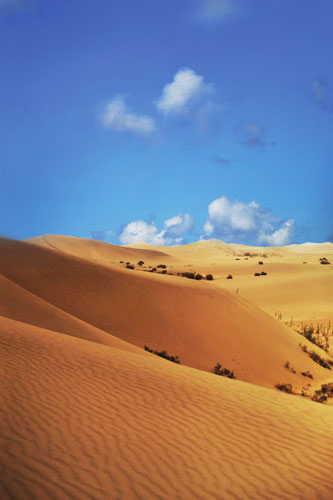
Xinjiang, with a vast territory abounding in natural wealth, has the world’s second highest peak, K2, at 8,600 meters above sea level and also has the world’s second largest shifting sand desert, Taklimakan Desert. Ayding Lake, located in the Turpan Depression in Xinjiang, is China’s lowest depression at 154 meters below sea level. Xinjiang also has a boundless expanse of prairie. Demographic Situation On 5th May 2011, the Statistics Bureau of Xinjiang Uyghur Autonomous Region published the data for the ‘Xinjiang Population Census’ as part of the Sixth National Population Census. The whole autonomous region’s permanent resident population is 21,813,334 people, with 60% of them in distinct ethnic groups. The biggest ethnic group is the Uyghur race which has 8,345,622 people. There are 7,489,919 Han Chinese in total, and 1,245,023 Kazakhs. Overall, twenty two different ethnic groups have more than a thousand people. Culture
Xinjiang is a multi-ethnic region. Each ethnic group has their own characteristics regarding clothing, food, housing and transport due to the great variety of culture, tradition and beliefs among them. There is also a diverse range of religions practised in Xinjiang. The major religions include Islam, Buddhism, Lamaism (Tibetan Buddhism), Protestant Christianity, Catholicism, Eastern Orthodox and Shamanism. Over ten ethnic groups, contributing to more than half the population, are Muslim.
|
Copyrights 2015. WE∙Shalom International Ltd. All Rights Reserved. |
Home | About Us | Product | Partnerships | Ordering | News | Contact | |